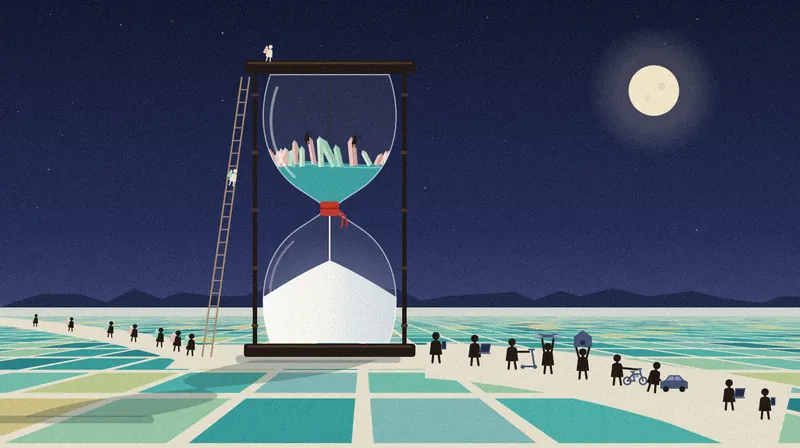
Consider two improbable fortunes of our time. A drinking flask, sold by a century-old company better known to campers than to influencers, carried Stanley’s revenue from roughly $73 million in 2019 to about $750 million by 2023. A start-up called Liquid Death persuaded investors to value it at $1.4 billion for selling water in a can, at several times the price of water in a bottle. Neither solved an unsolved problem. Both sold a small, affordable, visible proof of taste.
They are symptoms of a shift I have been watching for some time, and for which I found no adequate name. So I have given it one. I call it the Fragmentation Theory of Aspirational Spending.
Its central claim is simple. When a generation is priced out of the single great purchase around which its parents organised their financial lives, its aspiration does not disappear. It fragments, dispersing into hundreds of smaller, faster, more visible acts of consumption. The house is replaced not by thrift, but by a portfolio.
The House That Organised Everything
For most of the twentieth century, middle-class economic life orbited a single object. The house was the organising principle of an entire life: the reason for saving, the justification for sacrifice, the measure of arrival. The new sofa could wait; the holiday could wait indefinitely. Every lesser desire was pulled into the gravitational field of the down payment.
That arrangement depended on a piece of arithmetic that has quietly collapsed. In 1984, the median American home cost about 3.6 times the median household income. By 2022 it cost nearly 5.8 times. In the world’s most unaffordable cities, the figures belong to another order altogether: according to the 2026 Demographia survey, a home in Hong Kong costs 14.1 years of median household income, in Sydney 14, in San Jose more than 11. In Mumbai, Knight Frank estimates that servicing a typical home loan now consumes 69 per cent of household income, against a comfortable threshold of 50.
The consequences are visible in the queue at the bottom of the ladder. In 2025, first-time buyers made up just 21 per cent of American home purchases, the lowest share on record, and their median age reached 40. In the early 1980s, it was in the late twenties. A rite of passage has become a mid-life achievement.
When the Centre Cannot Hold
What happens to a generation that loses access to its economy’s anchor asset? Yeats supplied the image a century ago, in another context: things fall apart; the centre cannot hold.
One might have predicted austerity: a generation saving grimly towards an ever-receding goal. What has happened instead is more interesting. When the central status marker becomes unattainable, people do not stop signalling. They distribute the signal.
A house once told the world, in a single grand sentence, that its owner had arrived. The new consumer tells the same story in fragments: the latest phone, the designer bag, the specialty coffee, the elaborate skincare ritual, the limited-edition trainers. Each purchase is modest on its own. Together they constitute a portfolio of identity, diversified, liquid and perpetually rebalanced. The tragedy is in the accounting. Added up over a decade, the portfolio can rival a down payment. Unlike a house, it never compounds. It depreciates on contact.
Everything Went Premium
Look closely, and the market has rearranged itself around this fragmentation. Water now comes in branded cans. A bottle of Aesop hand wash sells for around $45, many times the price of a supermarket equivalent. Flaky sea salt commands a premium that has everything to do with texture and theatre and very little to do with chemistry.
Here the evidence offers a twist that, to my mind, strengthens the theory rather than weakening it. Traditional luxury is struggling. Bain and Altagamma estimate that the personal luxury goods market shrank by about 2 per cent in 2025, and that roughly 60 million consumers have left the luxury market since 2022. Yet the small premium purchase thrives, celebrated online as “little treat culture” and lamented in the financial press as “doom spending”. The fragmentation, in other words, is itself fragmenting. Aspiration has moved down the price ladder, from the Birkin to the tumbler, because the tumbler remains within reach.
The Treadmill Without a Finish Line
The house possessed one psychological property that its fragments lack: finality. One bought it, moved in and, whatever the upgrades that followed, experienced a sense of arrival. It was an end state.
Fragmented status has no end state. Phones are designed to feel obsolete within two or three years. Fashion turns with the seasons, skincare regimes with the algorithm, trainers with the drop calendar. Each purchase delivers a brief sensation of having made it, followed almost immediately by the need to make it again. The result is a treadmill with no finish line.
For companies, this is a gift. A house is bought perhaps once a decade; a phone every two years; a coffee every morning. Buyer and seller have aligned with remarkable precision: one substituting frequent small purchases for an unattainable large one, the other discovering that recurring premium revenue beats the occasional big-ticket sale.
The Stories We Tell Ourselves
The house came with a narrative of planning, sacrifice and deferred gratification rewarded with permanence.
The fragmented economy needs a new story, and it has found one in the language of self-optimisation. “I invest in quality.” “I buy it for life.” “This is self-care.” “It’s an investment piece.” These phrases perform a quiet alchemy, converting consolation into wisdom. Even minimalism, the apparent rejection of consumption, has been absorbed and resold as a premium aesthetic: owning fewer things, each at a much higher price. I can think of no better illustration of the theory’s reach than an anti-consumerist movement that ends in a $300 linen shirt.
The Arithmetic Nobody Wants to Do
The sums are uncomfortable. An extra $200 a month on premium versions of everyday things, sustained from 25 to 35, comes to $24,000. Invested at a modest 7 per cent, it would be closer to $35,000, a respectable down payment in many markets.
But that calculation assumes the house is attainable. When it is not, the logic inverts. Why save, for a decade, towards a door that keeps receding? Better to purchase utility and identity now. This is not irrationality; it is a rational response to an irrational market.
Economists have begun to model precisely this behaviour. In a 2025 paper titled “Giving Up”, Seung Hyeong Lee of Northwestern University and Younggeun Yoo of the University of Chicago find that as households’ perceived chances of owning a home fall, they consume more relative to their wealth, reduce their work effort and take riskier financial bets. Renters who still believe ownership is possible behave like savers; those who have given up behave like consumers. The effects compound across a lifetime and, worse, across generations.
The trap is self-reinforcing. The more one spends on distributed status, the less one saves towards the anchor; the further the anchor recedes, the more reasonable the spending appears.
A Theory and Its Ancestors
No theory arrives without ancestors, and honesty requires me to name mine. Thorstein Veblen described conspicuous consumption in 1899. Fred Hirsch explained in 1976 why status goods are inherently scarce. Juliet Schor documented how Americans began measuring themselves against ever-wealthier reference groups. Leonard Lauder of Estée Lauder popularised the “lipstick index”, the observation that small indulgences sell well when large ones become unaffordable, and psychologists have long studied compensatory consumption as a balm for blocked goals. Lee and Yoo have now shown, with data, that giving up changes behaviour.
What the Fragmentation Theory adds is a claim about structure rather than mere level. It argues, first, that the anchor asset once organised the entire architecture of aspirational spending, so that its loss rearranges that architecture rather than simply inflating it: one deferred aspiration becomes a distributed portfolio. Second, that the time horizon of aspiration has collapsed, from a single end state to a perpetual treadmill. Third, and most consequentially, that the change is likely to be sticky. Habits formed in response to a constraint can outlive the constraint itself.
Will the House Ever Matter Again?
Suppose house prices stabilised tomorrow. I am not persuaded that behaviour would snap back. A generation has learned to locate meaning in curation rather than accumulation. Economists call this hysteresis: the persistence of an effect long after its cause has gone.
The deeper question, then, is not whether homes will become affordable again. It is whether they would still command the same psychological authority if they did. We may already have entered a world in which identity is dispensed in smaller and more frequent doses.
And once a person has learned to feel successful through a thousand small signals rather than one large one, saving for years towards a distant goal no longer feels like maturity. It feels like punishment.
Sources: CNBC (Stanley, 2023); Liquid Death funding disclosures (2024); Joint Center for Housing Studies of Harvard University, price-to-income data as cited in coverage of Lee and Yoo (2025); Demographia International Housing Affordability (2026); Knight Frank India Affordability Index (H1 2026); National Association of Realtors, Profile of Home Buyers and Sellers (2025); Bain and Altagamma, Luxury Study (2025); Seung Hyeong Lee and Younggeun Yoo, “Giving Up” (SSRN, November 2025); Thorstein Veblen, The Theory of the Leisure Class (1899); Fred Hirsch, Social Limits to Growth (1976); Juliet Schor, The Overspent American (1998).