Published Research & Monographs
Books by
Shaurya Ritwik
Analytical frameworks for practitioners, policymakers, and investors shaping the future of sustainable finance, institutional strategy, and political economy. Forthcoming research on developing-market capital architecture in progress.
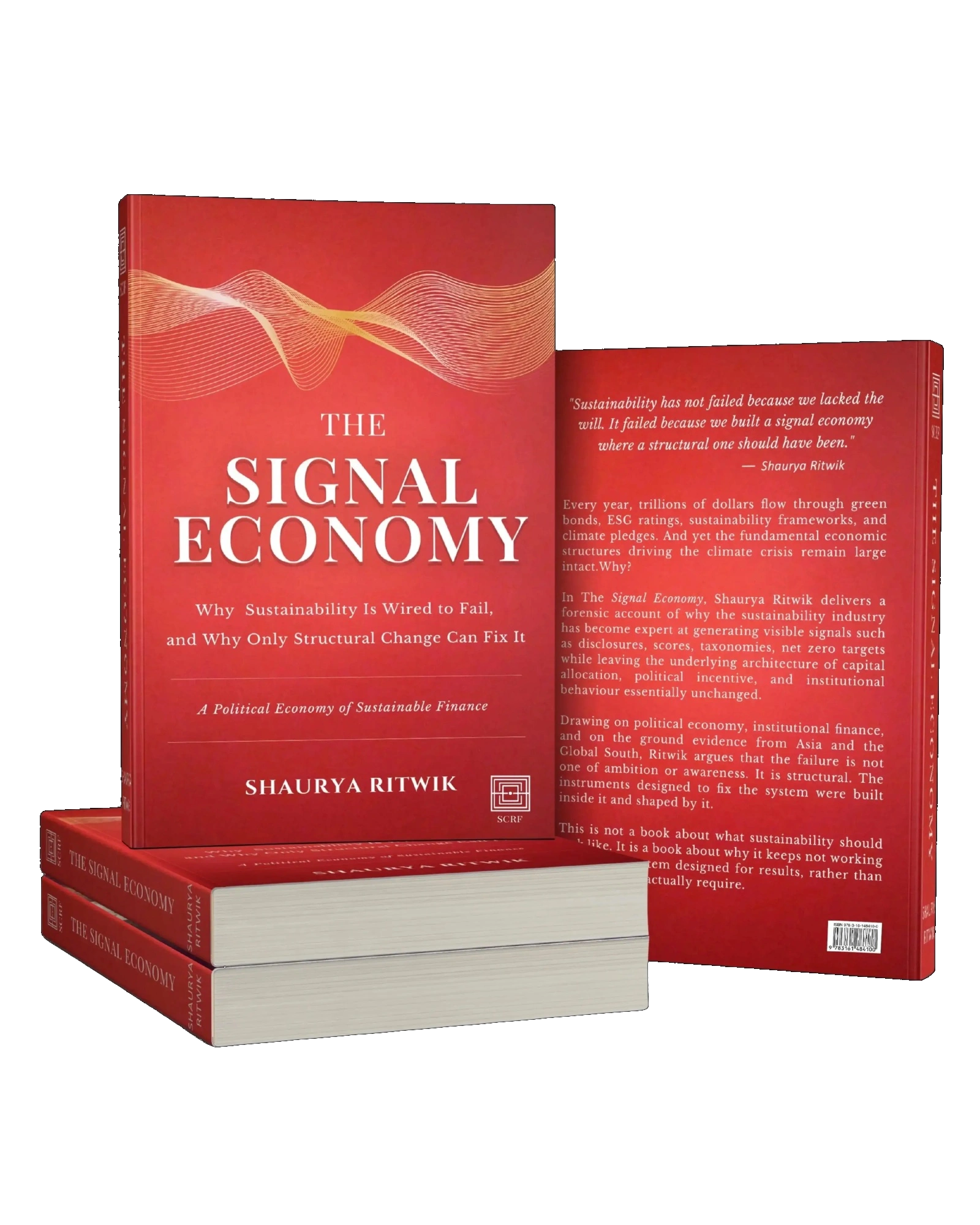
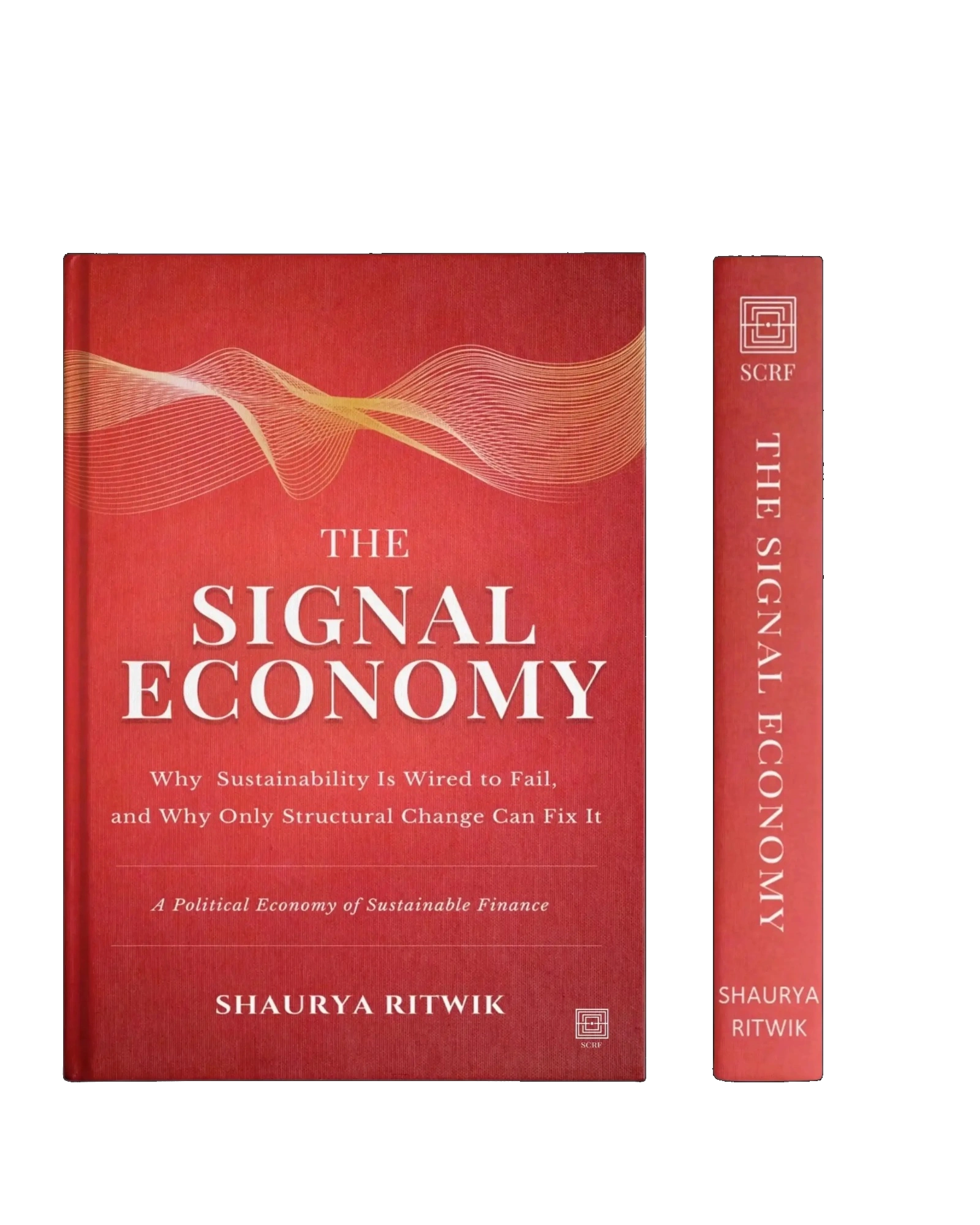
The Signal Economy
The Signal
Economy
Why Sustainability Is Wired to Fail, and Why Only Structural Change Can Fix It
A Political Economy of Sustainable Finance
Published by Sustainable Capital Research Foundation
Something is broken in the architecture of sustainability, and it is not the intentions behind it. ESG assets run into the trillions. Net-zero pledges cover the majority of the global economy. Climate disclosure has become a boardroom imperative. The physical numbers, emissions, biodiversity loss, and climate vulnerability, continue moving in the wrong direction.
Shaurya Ritwik argues this is not a coincidence. It is a design outcome.
Sustainability has built its own internal economy, one where institutions are rewarded for producing the right signals, disclosures, ratings, pledges, frameworks, regardless of what those signals actually deliver. Capital follows the signal. Governance tracks the signal. The outcome goes largely unmeasured, and largely unchanged.
Grounded in the structural realities of Asian markets and the institutional constraints of the Global South, the book offers original analytical frameworks for diagnosing where sustainability governance breaks down, identifying who bears the structural costs of misalignment, and determining what institutional change would actually move the needle.
This is not a book about bad actors or weak ambition. It is a book about systems functioning exactly as designed, and why that is precisely the problem. For policymakers, investors, regulators, and practitioners, it offers what most books in this space do not: a structural diagnosis and a credible path forward.
Signal vs. Outcome
Why institutions produce the right signals without delivering the right results
Asian & Global South Lens
Structural realities of emerging markets that prevailing sustainability models ignore
Institutional Reform
Frameworks for diagnosing breakdown and identifying what change would actually move the needle
"Capital does not move because targets are ambitious. Capital moves when risk is understood, when contracts are enforced, and when the institutions structuring the deal have the capacity to see it through."
Shaurya Ritwik · The Signal Economy
Inside the
book
10 chapters across 4 structural parts: from the failure of existing models to frameworks for genuine institutional reform.
Opening
Preface: Why Sustainability Fails
Part I
The Failure of the Current Model
- Chapter 1 Sustainability Without Results Why Good Intentions Have Not Produced Systemic Change
- Chapter 2 When Markets, Policy, and Incentives Misalign How Sustainability Breaks Down Inside Real Institutions
- Chapter 3 ESG as Signal, Not Solution What Disclosure Can and Cannot Fix
Part II
Capital, Power, and Structural Constraints
- Chapter 4 Capital Allocation Is the Real Climate Policy Why Finance, Not Awareness, Determines Outcomes
- Chapter 5 The Limits of Sustainable Finance Green Bonds, Taxonomies, Impact Investing and Their Boundaries
- Chapter 6 The State Never Left Why Governments and Development Finance Still Shape Sustainability
Part III
The Global Divide
- Chapter 7 One Transition, Unequal Starting Points Why Global North Sustainability Models Travel Poorly
- Chapter 8 Asia as Stress Test, Not Case Study What the World Learns from Scale, Speed, and Constraint
Part IV
Redesigning the System
- Chapter 9 What a Working Sustainability System Requires Principles for Alignment Across Policy, Finance, and Business
- Chapter 10 From Frameworks to Reality How Institutions Can Act Without Pretending the Trade-offs Do Not Exist
Conclusion
Sustainability as Political Economy
Secure your copy of
The Signal Economy
Available in Hardcover, Paperback, and Kindle editions via Amazon. Custom institutional shipments and academic course licensing available on request.