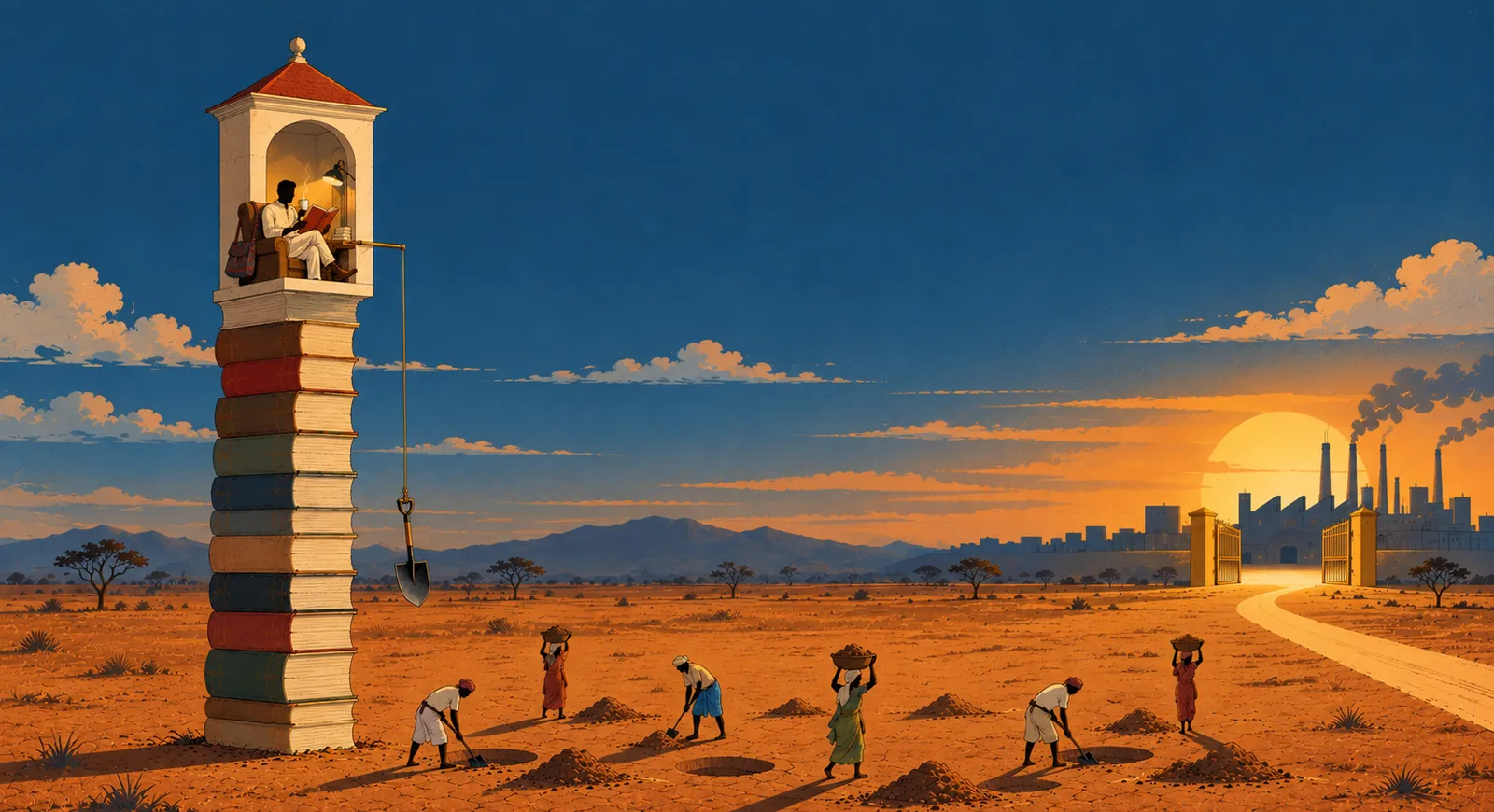
A short thread I wrote on X recently travelled far. It concerned Jean Drèze, who has lately re-emerged into public view after a long quiet, and the intellectual tradition he has come to embody. The reaction surprised me less by its volume than by its composition. I expected disagreement from socialist economists. I did not expect so many ordinary readers to rise in defence of a model of development that, by its own statistics, has never delivered what it promised. The anger was misplaced but sincere. That was the most instructive part.
Let me be clear about where my views come from. They are not the product of a seminar. They come from years spent in international and development finance, across South Asia, Southeast Asia, Africa and the Gulf, in the company of some of the brightest minds, sovereign negotiators, project financiers, central bankers and the people who build real enterprises with borrowed money and unforgiving deadlines. They come, too, from my own regional studies and understanding of how nations actually escaped poverty, as opposed to how we would like them to have escaped it. One lesson recurs for me with the regularity of a law. Socialist economics survives not on evidence but on sentiment, and on the considerable comfort of never having to deliver anything.
Many academics will find what follows controversial. Some will find it offensive. I have nothing personal against Professor Drèze. His early work on famine with Amartya Sen was serious scholarship, he has lived his convictions with a frugality, and I do not doubt that he cares about the poor. But sincerity is not a policy, and personal virtue, even performative is not a growth model. My argument is that the framework he did more than anyone to institutionalise has done India more harm than good, and that if we continue to treat it as the conscience of our economic policy, it will keep us poor.
The Romance of Scarcity
Every country has an aesthetic of virtue. In India, for much of the past half-century, that aesthetic has worn a jhola. The cloth shoulder bag of the activist-scholar became a badge of moral seriousness, a signal that its bearer stood with the poor and against the vulgar business of making money. Drèze himself once asked, with characteristic wit, whether it would make any difference if his fellow campaigners carried barristers’ briefcases instead. It would not. The problem was never the bag but what was inside it.
What was inside was a worldview that treats scarcity as virtue and ambition as a moral hazard. It is suspicious of profit, sceptical of markets, indulgent of the state and allergic to the idea that a poor person might become rich rather than merely less poor. In this vocabulary, the farmer is a victim to be protected, the labourer a beneficiary to be enrolled, and the entrepreneur a predator to be regulated. Nobody in the story is allowed to own anything.
India paid for this romance long before Drèze arrived. Our planners of the 1950s, enchanted by the Mahalanobis model and the Soviet example, built an economy around heavy industry, import substitution and the licence. By the 1970s the economist Raj Krishna had a name for the result, the “Hindu rate of growth”, a phrase he meant as a rebuke to policy rather than to faith. In 1974 Anne Krueger, studying India’s licensing regime, estimated that government controls generated rents worth about 7.3 per cent of national income in 1964. That was the coinage of a society in which the surest route to wealth was not to produce but to obtain permission. Gunnar Myrdal, surveying the region in Asian Drama in 1968, concluded that South Asia was condemned to a “soft state” and decades of stagnation. He was right about the softness. He was wrong about the destiny, as East Asia was about to demonstrate. He was right about India only for as long as India took his advice.
The romance was not confined to economics. It seeped into our culture. It made mediocrity respectable and turned modesty of ambition into a moral achievement. A nation that should have been asking how to build ten thousand factories spent its intellectual energy debating how to ration what little it had.
Custodial Economics
I want to give this tradition a name, because unnamed things are hard to argue with. I call it Custodial Economics.
Custodial Economics is a doctrine that treats the poor as permanent wards of the state rather than as aspiring producers, traders and owners of capital. Its instrument is the entitlement. Its unit of success is the outlay. Its natural habitat is the advisory council, the conference panel and the foreign journal. And it has three defining features.
First, it measures inputs rather than exits. Success is reckoned in rupees spent, days of work provided, households enrolled and rations distributed. A scheme that enrols more people this year than last is pronounced a triumph, although a growing caseload may be the clearest possible evidence of failure.
Second, it confers moral authority on the narrators of poverty rather than on those who end it. The scholar who documents deprivation in eloquent prose acquires a standing that the factory owner who employs four thousand people never will. Deprivation becomes a kind of capital, and those who describe it most movingly accumulate the most.
Third, and most corrosively, its institutional survival depends on the persistence of the condition it claims to cure. A movement whose relevance requires misery cannot be trusted to end it. This is the core of what is rightly called poverty porn. It romanticises deprivation, rewards those who narrate it, and quietly depends on the poor remaining poor.
Against this I propose a simple discipline, which I call the Exit Test. In my opinion every welfare scheme should be judged by one test: does it shrink the number of people who need it? A good programme is one that works itself out of a job. A ration card that is no longer needed is a success. A job card that is still needed after twenty years is an indictment.
Drèze’s influence on Indian policy peaked through the National Advisory Council, which Sonia Gandhi chaired from 2004 and which he served in both its incarnations. The council was an unelected parallel centre of power, sitting beside the Cabinet but answerable to neither Parliament nor the electorate. Drèze conceptualised and drafted the first version of the rural employment guarantee in 2004 and the original 2011 draft of the National Food Security Act. Entitlement followed entitlement.
The timing deserves attention. While the council drafted rights, the investment engine stalled. Gross fixed capital formation slipped from about 33 per cent of GDP in 2007-08 to under 30 per cent by 2012-13. The International Monetary Fund found that newly announced investment projects had fallen from around 10 per cent of GDP in 2006-07 to just 1 per cent in 2012-13, while stalled and shelved projects had climbed above 2.5 per cent of GDP. Growth fell to around 5 per cent. The global financial crisis, high interest rates and corruption scandals all played their part, and I do not lay the whole of the policy paralysis at the council’s door. But a government’s attention is finite. In those years, the moral energy of the Indian state was spent on designing new claims on wealth while the clearances that would have created it gathered dust.
Anatomy of a Shovel
Admirers of Drèze speak of the Mahatma Gandhi National Rural Employment Guarantee Act with something close to reverence. That tells you a great deal. If a two-decade intellectual legacy rests on a scheme that paid people to dig pits one season and refill them the next, the legacy is weaker than its devotees imagine.
The pit-digging image is a caricature, and I use it knowingly. Some MGNREGA assets were real: ponds, check dams, rural roads. But caricatures endure because they contain a truth, and the auditors found plenty of it. The Comptroller and Auditor General’s 2013 performance audit found 7.69 lakh works worth ₹4,070.76 crore still incomplete one to five years after they were begun. It found ₹6,547.35 crore spent on works that created no durable asset at all. It found more than a lakh of inadmissible works and, in nearly a third of sampled gram panchayats, no proper annual plan. A programme that cannot say what it built is not a development programme. It is a consumption subsidy dressed in the costume of work.
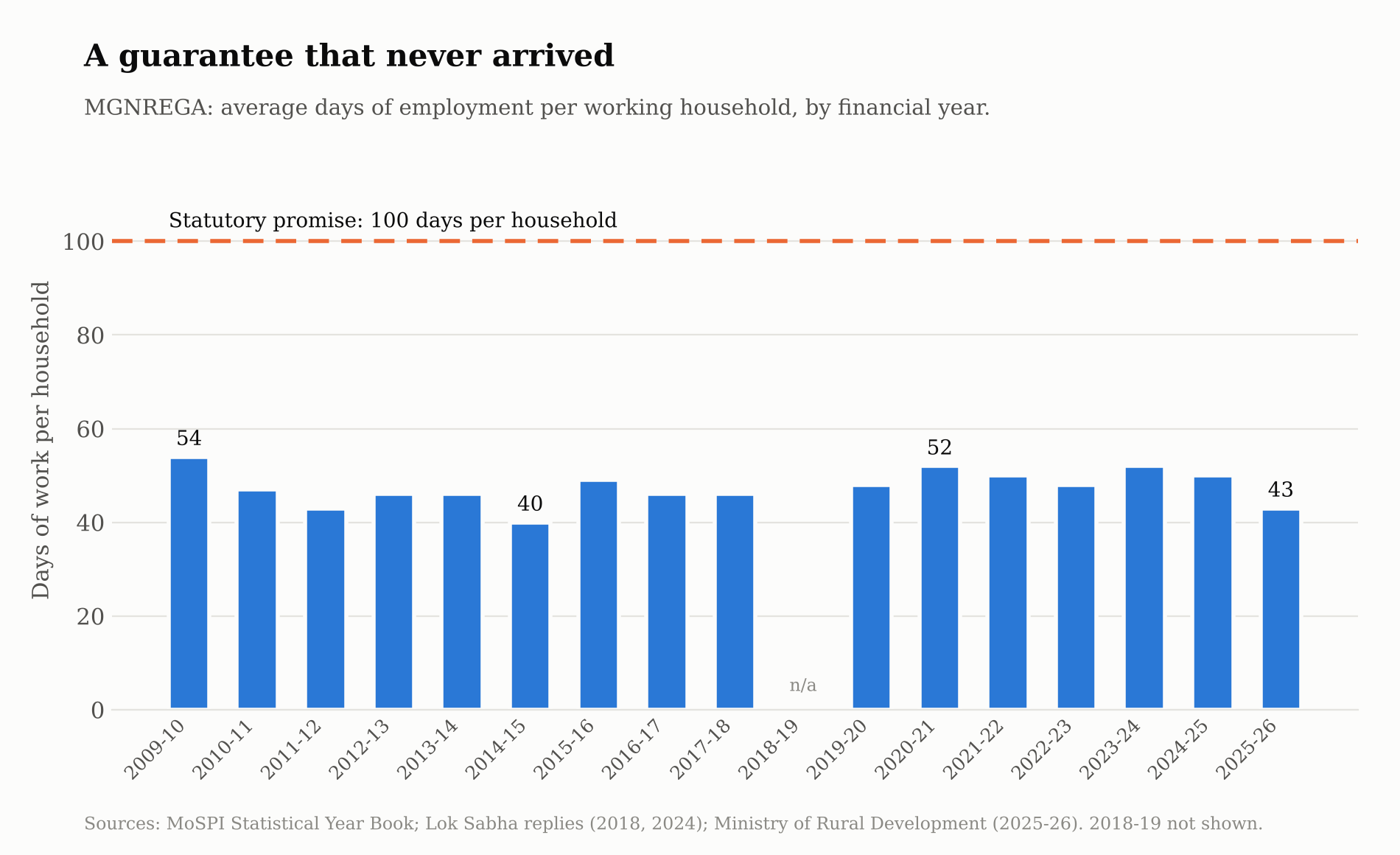
The deeper failure was the promise itself. The Act guaranteed one hundred days of employment to every rural household that asked. In no year of its existence did the average household receive even sixty. In 2013-14, by the government’s own Statistical Year Book, barely 9.6 per cent of employed households completed the promised hundred days. Since 2018-19, the average has been about 7.4 per cent. In 2025-26, the scheme’s final full year, the average working household received just 43 days. If this is the grand success of a poverty alleviation model, one wonders what failure would look like.
Intellectual honesty requires me to state the strongest case on the other side. It is a good one. In a rigorous randomised study published in Econometrica in 2023, Karthik Muralidharan, Paul Niehaus and Sandip Sukhtankar found that when Andhra Pradesh improved the scheme’s payment system, the earnings of participating households rose by about 13 per cent. During the pandemic year of 2020-21, a record 7.55 crore households turned to the scheme as migrants streamed home from shuttered cities. A wage floor and a crisis insurance policy have real value, and I would not deny it.
But read the Andhra study closely and it makes my argument for me. Close to nine-tenths of the income gains came not from the programme itself but from the private labour market, through higher market wages and more private employment. The authors attribute much of the effect to imperfectly competitive rural labour markets rather than to productivity gains, though they also record a welcome rise in non-farm enterprises. The scheme helped most where it pushed wages towards what a functioning market would have paid. That is an argument for functioning markets. It is not an argument for twenty years of paying for activity instead of building capacity.
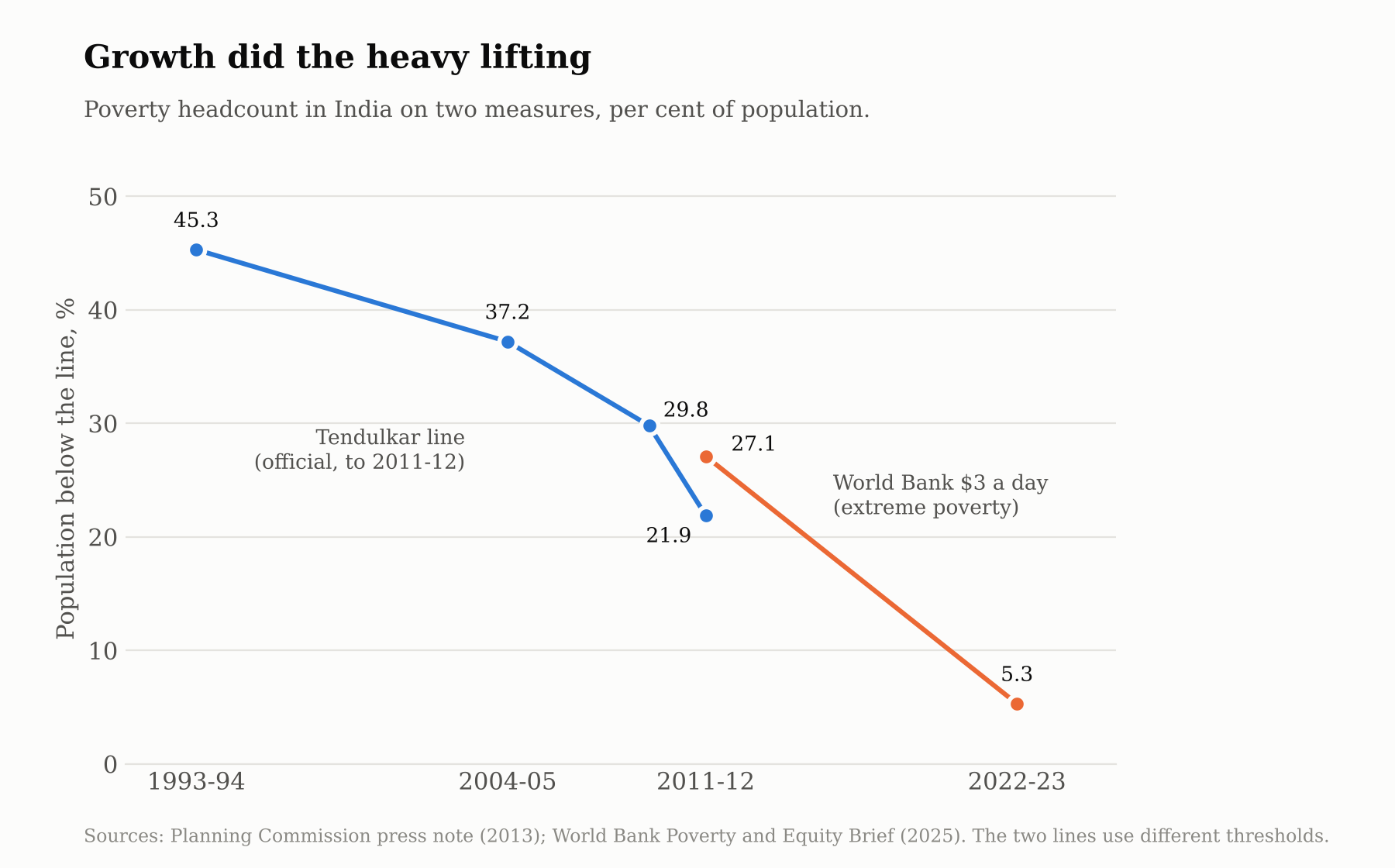
Consider also the cost of opportunity. MGNREGA absorbed roughly a third of one per cent of GDP each year. That is not a vast sum, which is precisely the point. Between 2004-05 and 2011-12, India’s poverty rate fell from 37.2 to 21.9 per cent on the Tendulkar line, the fastest decline in our history. Drèze’s admirers like to credit their scheme. It is an implausible attribution. A programme costing a third of one per cent of GDP, delivering under fifty days of work a year to its participants, did not lift a hundred and thirty-seven million people out of poverty in seven years. Sustained rapid growth did.
There is a final, quieter charge, and it is the most serious. The CAG’s audit of the scheme in Andhra Pradesh noted that it was accompanied by reduced migration to urban areas. Its defenders count this as a virtue. I count it as the heart of the problem. The single most powerful engine of poverty reduction in modern history is the movement of labour from low-productivity farms to higher-productivity factories, workshops and cities. A scheme that pays people to stay where productivity is lowest does not fight poverty. It embalms it. Worse, it taught an entire rural generation that the highest aspiration the state held for them was manual labour at subsistence wages.
Parliament has now repealed the Act. The Viksit Bharat Guarantee for Rozgar and Ajeevika Mission (Gramin) Act, passed in December 2025, replaced it from 1 July 2026. The successor raises the guarantee to 125 days and ties the works to village development plans. I welcome the break, but I will hold the new law to the same standard as the old. A longer guarantee is not, by itself, a better one. The question is not how many days the state can promise. It is how many families will no longer need them.
What Beijing Understood
Contrast China, which faced a rural surplus far larger than ours and chose a different instrument.
Deng Xiaoping, surveying the wreckage of the Maoist years, drew a conclusion that would have scandalised our planners. The experience of the twenty years from 1958 to 1978, he said in 1985, taught that poverty is not socialism. Socialism, in his formulation, meant eliminating poverty, and that required developing the productive forces. It is a remarkable sentence for a communist to have uttered. It is a sentence no Indian Custodial Economist has ever managed.
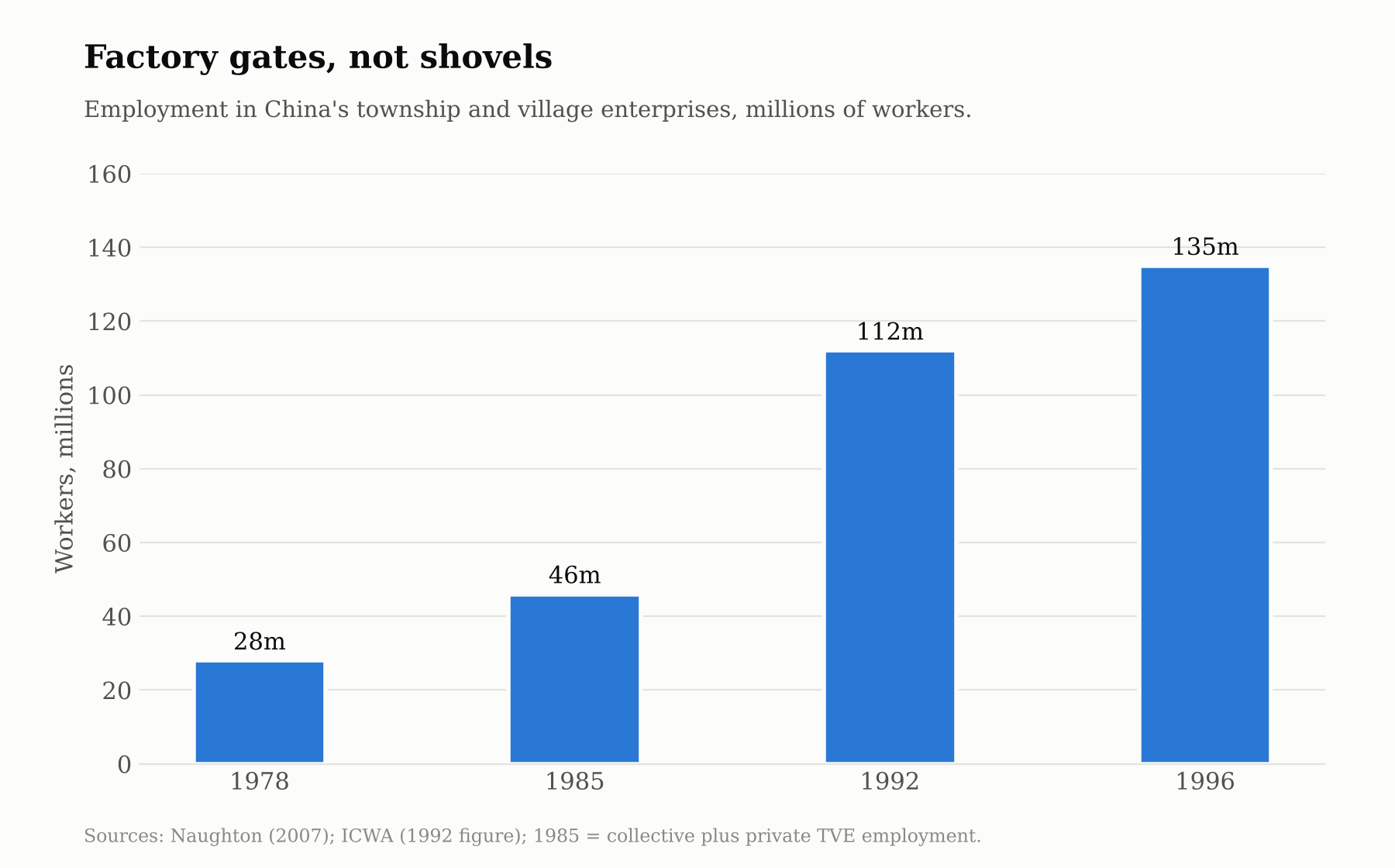
Beijing did not respond to rural poverty with a guarantee of manual work. It did three things. It let farmers keep what they grew above a quota, under the household responsibility system, and agricultural productivity leapt. It allowed townships and villages to establish enterprises that produced for markets, and the township and village enterprises became the most dynamic part of the economy. Their employment rose from 28 million in 1978 to a peak of 135 million in 1996, and their share of GDP from under 6 per cent to about 26 per cent. And it opened special economic zones, beginning with Shenzhen, that pulled tens of millions of rural workers into export manufacturing.
The results are known. Over four decades, according to a joint report by the World Bank and China’s Development Research Center, close to 800 million Chinese escaped extreme poverty, about three-quarters of the entire global reduction over the period. No ration card did that. Factories, exports, savings and relentless capital formation did.
The difference between China and India was not compassion. It was the direction of travel. China moved its rural surplus labour into enterprises, ports and export corridors, exactly as the Nobel laureate Arthur Lewis had predicted a developing economy must. It built capability that compounded. India, in the same decades, spent its rural policy keeping labour in place and paying it to be busy. We called it a rights revolution. The Chinese called it what it was, a transition.
A caveat, before Beijing’s admirers get carried away. Economics has only one honest law: everything costs something, and the price is whatever you gave up to get it. China paid in full. Its household registration rules made migrants second-class citizens in the very cities they built. Its township enterprises poisoned the rivers that ran past them, and many withered after the mid-1990s once land rules tightened. No economic system is utopian. Communism alone looks perfect, which is why it has always done best in faculty lounges and dormitories, where the supply is good and the consequences are borne by someone else. Sober up and the trade-offs reappear. One need not admire Beijing’s politics to learn from its economics.
The East Asian Grammar
China was not the first to learn this. It was merely the largest.
In 1960, South Korea was poorer than Ghana. World Bank data put Korea’s GDP per head at about $159 that year, against Ghana’s $175. Korea had been devastated by war, had few natural resources and was routinely dismissed as a basket case. Ghana had cocoa, gold, a functioning civil service and the goodwill of the world. By 2025 Korea’s income per head stood at about $36,200. Ghana’s stood at about $3,300.
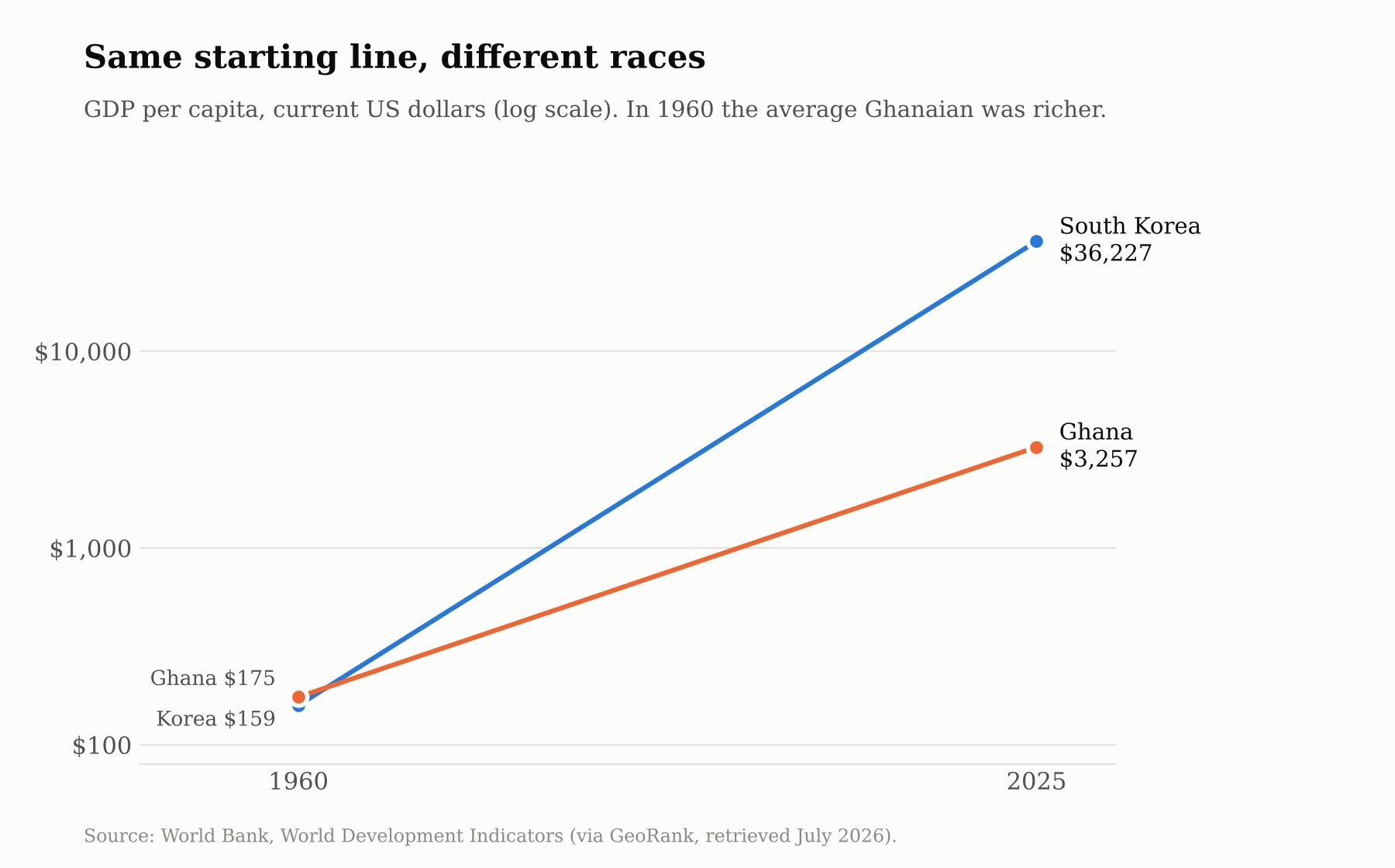
Korea did not redistribute its way to that outcome. Under Park Chung-hee, the state set export targets, presided personally over export-promotion meetings, and rewarded the firms that met them with credit and punished those that did not. Savings were mobilised with almost puritanical zeal. Education was treated as industrial infrastructure. Welfare came later, and when it came it was built on a tax base that factories had created.
Taiwan followed a gentler version of the same grammar: land reform that turned tenants into owners, followed by a dense web of small and medium manufacturers selling to the world. Singapore, under Lee Kuan Yew, regarded the Western welfare state with open suspicion and built instead a system of compulsory savings through its Central Provident Fund, so that citizens accumulated assets rather than claims. Japan before them had shown that a resource-poor nation could become an industrial power through exports, discipline and investment.
The grammar of East Asian success is not complicated. Savings, investment, exports, factories, skills, and a state that measures itself by output rather than outlay. Welfare existed, but it was a cushion beneath a ladder, never a substitute for one. No nation has ever redistributed its wealth in a way that has led to prosperity.
Where the Other Road Led
The counterfactual is not hypothetical. Asia and Africa ran the experiment, and the poor paid for it.
In Tanzania, Julius Nyerere launched Ujamaa, an African socialism of collective villages. Peasants were reluctant to join, so from 1973 residence in planned villages was made compulsory. Estimates of those resettled, often by force, run from five million to more than eight million. Agricultural output, which had been growing, collapsed, and through much of the 1970s a largely agrarian nation had to import maize to feed itself. Nyerere was a man of genuine integrity and enormous moral prestige, revered abroad as Mwalimu, the teacher. His intentions were impeccable. His economics impoverished his people.
In Ghana, Kwame Nkrumah’s state-led industrialisation built enterprises that produced losses more reliably than goods, and squandered the inheritance that should have made his country Korea’s equal. In Burma, General Ne Win’s “Burmese Way to Socialism”, launched in 1962, nationalised the economy of what had once been among Asia’s great rice exporters. By 1987 the country had sought, and received, the United Nations’ designation as a least developed country. India’s own licence raj belongs in this company, a gentler and more democratic variant of the same error.
These experiments shared an intellectual architecture that deserves its own scrutiny. Dependency theorists taught a generation that trade with rich nations was a trap. Export pessimists such as Raúl Prebisch taught that poor countries could never compete in world markets and should build walls instead. Planners taught that the state could allocate capital better than prices could. Each idea had its distinguished professors, its prestigious journals and its admiring conferences. And each was falsified, at enormous human cost, by the countries that ignored it.
What strikes me most is the asymmetry of consequences. The professors kept their chairs. The peasants lost their land, their harvests and, in too many cases, their lives. Peter Bauer spent decades warning that state planning and foreign aid would entrench the very poverty they claimed to fight. His profession largely dismissed him in his lifetime. History has vindicated him. Aid, like the employment guarantee, measures generosity by what is spent rather than by what is built. It rewards governments for managing poverty, not for ending it, and it sustains a lucrative industry of consultants, evaluators and conference speakers whose livelihoods depend on the problem remaining unsolved. Half a century of transfers has not made a single African nation rich. Every country that escaped poverty in that time did so by producing, saving and exporting its way out.
I Scratch Your Back
Why, then, does Custodial Economics endure? If the evidence is so lopsided, why did so many readers rush to defend it when I criticised one of its leading practitioners?
The answer is not intellectual. It is institutional. Custodial Economics sustains an ecosystem, and ecosystems defend themselves.
Consider how the system works. A scholar documents deprivation in a village. The documentation becomes a paper in a foreign journal. The paper earns a fellowship, the fellowship a seat on an advisory body, the advisory body a scheme, and the scheme a new field for documentation. Donors fund the non-governmental organisations that implement the scheme. The organisations commission the scholars who evaluate it. The evaluations recommend expansion, which requires more funding, more implementation and more evaluation. Citations circulate within a closed circle. Panels at literary festivals feature the same faces. Reviews of each other’s books are reliably warm. I scratch your back; you scratch mine.
Nobody in this loop needs to be corrupt for the loop to be perverse. Each participant may act in perfect good faith. But the incentives of the system as a whole point in one direction. Its prestige, its funding and its relevance all grow with the size of the problem it addresses. It has no stake in a world where the problem has gone away. Krueger described the rent-seeking society of licences and permits. Custodial Economics is a rent-seeking society of the conscience, in which the currency is not an import licence but moral authority, and the rents accrue to those who speak for the poor rather than to the poor themselves.
The tell is in what the ecosystem chooses to measure. It celebrates the number of households enrolled, the size of the budget and the expansion of entitlements. It rarely asks how many families left the scheme because they no longer needed it. It describes any reduction in outlays as an assault on the poor, even when the reduction follows from rising incomes. It regards a growing caseload as proof of need rather than as evidence of failure. Ask it to apply the Exit Test and it changes the subject.
In 2013 India witnessed a revealing public quarrel. Drèze and Sen published An Uncertain Glory, which argued that India’s growth had neglected health, education and nutrition. In the same year Jagdish Bhagwati and Arvind Panagariya published Why Growth Matters, which argued that growth was the precondition for financing any of those things, and that rapid growth itself was the most powerful anti-poverty programme India had ever run. The debate was conducted with considerable acrimony. A decade later, the evidence has rendered its verdict. India’s extreme poverty fell from 27.1 per cent in 2011-12 to 5.3 per cent in 2022-23 on the World Bank’s revised measure. That is roughly 269 million people. They were lifted by an economy that grew, built and connected, not by an economy that rationed more generously.
Ladders, Not Hammocks
None of this is an argument against welfare. A civilised society catches those who fall. Food in a famine, cash in a pandemic, care for the old and the disabled: these are obligations, not indulgences. Welfare can cushion a fall. It can never build a ladder.
The distinction matters because the two require different designs. A cushion is meant to be temporary. It is judged by how quickly the person resting on it can stand again. A hammock is meant to be comfortable. It is judged by how long its occupant stays. Custodial Economics has spent two decades designing hammocks and calling them ladders.
What would a ladder look like? It would begin by applying the Exit Test to every scheme in the budget, and publishing the results. It would favour programmes with built-in graduation, so that support tapers as incomes rise and the beneficiary is rewarded rather than penalised for progress. It would treat apprenticeships, vocational training and urban housing for migrants as anti-poverty policy, because they are. It would make it easier to buy, sell and lease rural land, so that farmers can raise capital and enterprises can find space. It would reform labour laws that deter firms from growing past a handful of workers. It would treat the low participation of Indian women in paid work as the single largest untapped resource in the economy. And it would measure its own success not by how much it spends on the poor but by how many of them it no longer needs to spend on.
Most of all, it would recognise who actually pays for every social programme. Only wealth creators can lift a civilisation out of its slumber, because only they generate the jobs, the tax revenues and the productivity on which every welfare scheme ultimately depends. The Custodial Economist sees the entrepreneur as an obstacle to justice. In truth, the entrepreneur is its financier. India needs entrepreneurs, engineers and manufacturers. It does not need more jholachhapeconomists, to borrow the Hindi word for a quack physician who has never earned his licence but dispenses remedies all the same.
The Kindness That Does Not Compound
I return, in closing, to the readers who were so angered by my thread. I think I understand them now. They were defending not a policy but a feeling: the feeling that someone, somewhere, was on the side of the poor. That feeling is worth having. It is also worth examining, because it has been exploited for decades by a school of thought that has offered the poor a great deal of sympathy and very little escape.
Compassion that does not compound is merely sentiment. A scheme that is needed by more people after twenty years than when it began is not a monument to kindness. It is a monument to the failure of ambition. The question we should ask of any economist, any programme and any movement that claims to speak for the poor is the one I have proposed throughout: does it shrink the number of people who need it?
Jean Drèze built a scheme that kept millions busy. China, Korea, Taiwan and others built economies that made millions unnecessary to their welfare systems. One of these is a legacy. The other is a lesson.
Our poor never needed a perpetual shovel. They needed a factory gate, a payslip, and a reason to believe that their children would need neither the shovel nor the scheme.
Sources: Ministry of Statistics and Programme Implementation, Statistical Year Book (rural development chapter, 2013-14 data); Lok Sabha and Rajya Sabha replies on MGNREGA (2018, 2024); Ministry of Rural Development statements (2025-26); Comptroller and Auditor General of India, Report No. 6 of 2013 and the Andhra Pradesh performance audit (2013); PIB, notification of the VB-G RAM G Act (May 2026); Planning Commission, Press Note on Poverty Estimates 2011-12 (2013); World Bank, India Poverty and Equity Brief (2025); World Bank and Development Research Center of the State Council, Four Decades of Poverty Reduction in China (2022); Barry Naughton, The Chinese Economy (2007); World Bank, World Development Indicators; IMF Working Paper on India’s investment slowdown (2013); Business Standard GFCF series (2013); Karthik Muralidharan, Paul Niehaus and Sandip Sukhtankar, “General Equilibrium Effects of (Improving) Public Employment Programs”, Econometrica (2023); Anne O. Krueger, “The Political Economy of the Rent-Seeking Society”, American Economic Review (1974); Deng Xiaoping, Selected Works (1985); Rob Jenkins, review of The Battle for Employment Guarantee, EPW (2012); Brown University NAC archive; Gunnar Myrdal, Asian Drama (1968); Jean Drèze and Amartya Sen, An Uncertain Glory (2013); Jagdish Bhagwati and Arvind Panagariya, Why Growth Matters (2013).