Published Research & Monographs
Books & Research
by Shaurya Ritwik
Ideas and analytical frameworks on sustainable finance, institutional design and political economy—examining why systems produce the outcomes they do, and what structural change requires.
Further research on emerging-market capital architecture is in development.
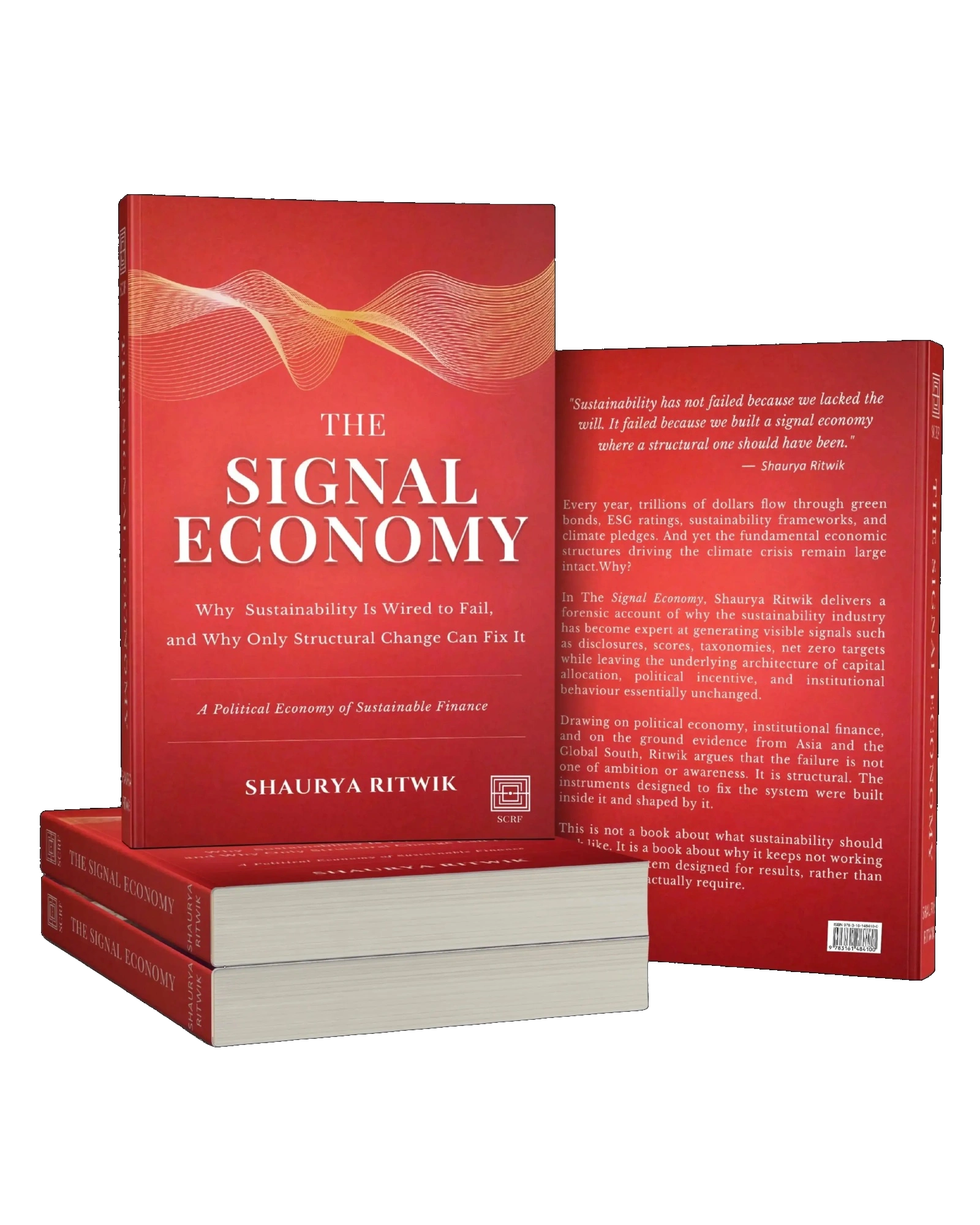
Featured Publication
The Signal
Economy
Why Sustainability Is Wired to Fail, and Why Only Structural Change Can Fix It
Something is broken in the architecture of sustainability—and it is not a lack of ambition.
ESG assets have grown into the trillions, net-zero commitments have spread across the global economy, and climate disclosure has become a boardroom priority. Yet the relationship between sustainability commitments and measurable outcomes remains deeply contested.
In The Signal Economy, Shaurya Ritwik argues that this is not simply an execution failure, but a design problem. Institutions are rewarded for producing disclosures, ratings, pledges and frameworks, even when the relationship between these signals and real-world results remains weak.
Drawing on the institutional realities of Asian markets and the wider Global South, the book examines how incentives, capital allocation and governance shape sustainability outcomes—and what institutional reform would require.
For policymakers, investors, regulators and practitioners, it offers a structural framework for understanding why well-intentioned systems underperform and where meaningful change must begin.
Available Now
Signal vs. Outcome
Why institutions produce the right signals without delivering the right results
Asian & Global South Lens
Structural realities of emerging markets that prevailing sustainability models ignore
Institutional Reform
Frameworks for diagnosing breakdown and identifying what change would actually move the needle
“Capital does not move because targets are ambitious. Capital moves when risk is understood, when contracts are enforced, and when the institutions structuring the deal have the capacity to see it through.”
Inside the Book
From Diagnosis to
Institutional Reform
Ten chapters across four parts trace the structural failures of contemporary sustainability, examine how capital and power shape outcomes, explore the unequal starting points of emerging economies, and develop principles for institutional reform.
Opening
Preface: Why Sustainability Fails
Part IThe Failure of the Current Model
-
Chapter 1: Sustainability Without ResultsWhy Good Intentions Have Not Produced Systemic Change
-
Chapter 2: When Markets, Policy, and Incentives MisalignHow Sustainability Breaks Down Inside Real Institutions
-
Chapter 3: ESG as Signal, Not SolutionWhat Disclosure Can and Cannot Fix
Part IICapital, Power, and Structural Constraints
-
Chapter 4: Capital Allocation Is the Real Climate PolicyWhy Finance, Not Awareness, Determines Outcomes
-
Chapter 5: The Limits of Sustainable FinanceGreen Bonds, Taxonomies, Impact Investing and Their Boundaries
-
Chapter 6: The State Never LeftWhy Governments and Development Finance Still Shape Sustainability
Part IIIThe Global Divide
-
Chapter 7: One Transition, Unequal Starting PointsWhy Global North Sustainability Models Travel Poorly
-
Chapter 8: Asia as Stress Test, Not Case StudyWhat the World Learns from Scale, Speed, and Constraint
Part IVRedesigning the System
-
Chapter 9: What a Working Sustainability System RequiresPrinciples for Alignment Across Policy, Finance, and Business
-
Chapter 10: From Frameworks to RealityHow Institutions Can Act Without Pretending the Trade-offs Do Not Exist
Conclusion
Sustainability as Political Economy
- Acknowledgements
- References
- Index
Continue the Conversation
The Signal Economy is available through Amazon. Institutional enquiries are welcome for bulk orders, academic course adoption and related educational use.